Green Blossom Spring Clipart: A Practical Asset for Creative Workflows
In the realm of digital design and small business production, the selection of high-quality assets often dictates the efficiency and final aesthetic of a project. Green Blossom Spring Clipart represents more than just a collection of images; it serves as a foundational element in the planning and execution phase of various creative endeavors. For professionals ranging from freelance graphic designers to DIY crafters managing a home-based business, integrating these specific floral elements into a workflow requires an understanding of file specifications, compatibility, and application strategies. This guide explores how to effectively utilize this digital resource within your existing processes to maximize output quality and operational speed.
Understanding the Asset Specifications and Technical Requirements
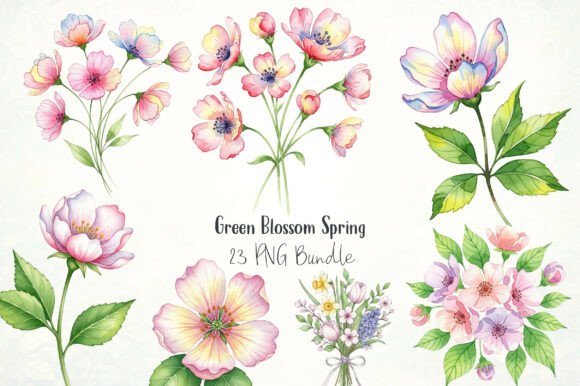
Before incorporating any digital asset into a production pipeline, it is critical to evaluate its technical parameters against your hardware and software capabilities. The Green Blossom Spring Clipart package is designed with professional standards in mind, offering 23 distinct designs delivered in PNG format. The choice of PNG is deliberate, providing a transparent background that allows for seamless layering over various substrates without the need for manual background removal. This feature significantly reduces post-processing time, allowing creators to move directly from concept to mockup.
The resolution of these files is specified at 300 DPI with dimensions of 12″ x 12″ (3600 × 3600 pixels). In a practical workflow, this high resolution ensures that the imagery remains crisp when printed on large-format items or when viewed on high-definition screens. Unlike lower-resolution web graphics, these files maintain their integrity during resizing operations. However, users must note that while the files are scalable, they are raster-based images. This means they should not be confused with vector formats like SVG. Understanding this distinction is vital for decision-making regarding the intended use case. If a project requires infinite scalability without pixelation, such as a massive billboard, a vector source would be preferable. Yet, for standard commercial applications like apparel, mugs, and stationery, the provided 300 DPI PNGs offer sufficient fidelity and detail.
Integrating Assets into Pre-Production Planning
Effective project management begins before the first design tool is opened. When planning a spring-themed product line or a seasonal marketing campaign, the Green Blossom Spring Clipart can serve as the visual anchor. During the ideation phase, creators can review the included styles—Solid Color and Distressed Effect—to determine which aesthetic aligns best with their brand identity or client requirements. The Solid Color style offers a clean, modern look suitable for minimalist designs, while the Distressed Effect adds texture and character, ideal for vintage or rustic themes.
Organizing these assets within a digital library is a crucial step in maintaining workflow efficiency. Since the files are delivered in a .ZIP format, the immediate task upon purchase involves extracting the contents. It is essential to ensure familiarity with unzipping procedures on both PC and Mac operating systems to prevent data loss or corruption. Once extracted, the files should be stored in a structured directory system, perhaps categorized by season, style, or color palette. This organization facilitates rapid retrieval during the active design phase, reducing friction and keeping the creative momentum intact. By preparing the file environment beforehand, you eliminate potential bottlenecks related to file management later in the process.
Execution Strategies for Physical and Digital Products
The versatility of the Green Blossom Spring Clipart extends across multiple mediums, making it a valuable resource for diverse production workflows. For entrepreneurs engaged in Print-on-Demand (POD) services, these high-resolution PNGs are ready for upload to platforms specializing in T-shirts, tote bags, and pillows. The transparent background simplifies the overlay process, ensuring that the green blossoms integrate naturally with the base color of the garment or product.
In sublimation projects, where ink is transferred onto polyester fabrics or coated ceramics, the color accuracy and resolution of the clipart become paramount. The 3600 × 3600 pixel size provides ample detail for mug wraps and other cylindrical objects. However, practitioners must account for variable factors such as printer settings and device calibration. Colors may appear differently on a monitor compared to the final printed product. To mitigate this, it is advisable to print test swatches before committing to a full production run. This quality control step ensures that the vibrant greens and delicate details of the blossoms translate accurately to the physical medium.
For those involved in educational materials or digital publishing, these assets can enhance worksheets, e-books, and blog graphics. The ability to resize the images without losing quality allows for flexible layout adjustments. Whether used as a decorative border, a central illustration, or a subtle watermark, the Green Blossom Spring Clipart adapts to various compositional needs. This adaptability supports a streamlined workflow where a single asset can serve multiple purposes across different content types.
Workflow Optimization and Long-Term Usability
Sustaining a productive creative routine involves not only the acquisition of tools but also the development of habits that support long-term usability. The Green Blossom Spring Clipart is part of a broader ecosystem of digital resources. To stay inspired and efficient, creators should consider following the source store and engaging with new collections as they are released. Regular updates to design libraries ensure that portfolios remain fresh and relevant, preventing stagnation in visual output.
Consistency in branding is another factor where these assets play a role. By utilizing the same set of clipart across various products—such as matching T-shirts, mugs, and packaging—a business can establish a cohesive visual identity. This consistency aids in brand recognition and customer loyalty. Furthermore, understanding the limitations and strengths of the file format helps in setting realistic expectations with clients or customers. Clearly communicating that the product is digital-only and explaining the benefits of high-resolution PNGs can streamline the sales process and reduce post-purchase inquiries.
Practical Considerations for Implementation
When executing a project using these designs, several practical considerations arise. First, verify software compatibility. Most industry-standard graphic design applications, including Adobe Photoshop, Illustrator, Canva, and GIMP, support PNG files with transparency. Ensure that your chosen platform handles high-resolution images efficiently to avoid lag during editing. Second, consider the color profile of your working environment. Working in sRGB is generally safe for digital display and most online printing services, but always check the specific requirements of your printing provider.
Additionally, the inclusion of two distinct styles within the pack allows for A/B testing in a marketing context. You might create two variations of a product listing—one featuring the Solid Color version and another with the Distressed Effect—to gauge customer preference. This data-driven approach can inform future purchasing decisions and design strategies. By treating the clipart not just as a static image but as a variable in a larger experimental framework, you add value to the asset beyond its immediate visual appeal.
Finally, remember that the delivery mechanism is purely digital. No physical item will be shipped, which emphasizes the importance of having a reliable internet connection and storage solution. Back up the extracted files to a cloud service or external drive to safeguard your investment. This redundancy ensures that even if local hardware fails, the assets remain accessible for future projects. By adhering to these organizational and technical protocols, the Green Blossom Spring Clipart becomes a reliable, repeatable component of a successful creative workflow.